Gunnison Sage Grouse Information for Owners of Conservation Lands
UPDATED DECEMBER 2014
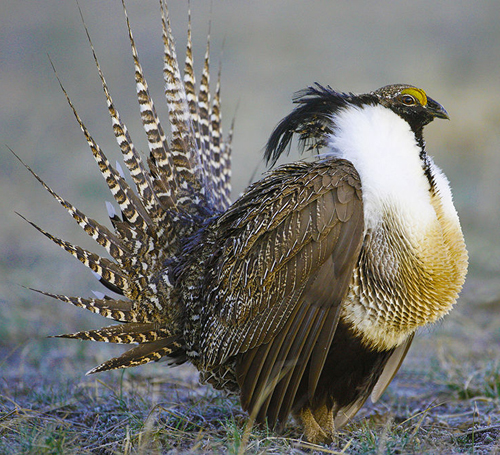 After years of scientific research, collaboration, and stakeholder negotiations, The U.S. Fish & Wildlife Service (USFWS) announced in mid-November 2014, the much anticipated listing of the Gunnison sage-grouse (GUSG) as a threatened species under the Endangered Species Act (ESA). GUSG are considered obligate users of sage brush dominated habitats and are believed, at one time, to have been numerous throughout southwestern Colorado, southeastern Utah, northwestern New Mexico, and northeastern Arizona. They were first recognized as a unique species in 2000, and are now believed to occupy only 7-12% of their historical range. Threats to GUSG generally include habitat loss and fragmentation, small population size, human development pressures, drought, and disease.
As of the listing date, approximately 4,700 birds have been documented within seven geographically isolated areas scattered across the Gunnison and San Miguel Basins of southwestern Colorado and extreme southeastern Utah. GUSG populations are unfortunately struggling in all but the largest concentration area, located in the upper Gunnison Basin. And the species’ long-term survival is far from certain. In a nutshell, it’s the instability within these at-risk “satellite” populations that ultimately forced the Service to take action – a move in which roughly 1.4 million acres of critical habitat was designated by USFWS to combat further population decline.
What, you may ask, does the listing mean for privately conserved lands? The answer, for all intents and purposes, is little to no change on non-federal lands, according the Service. The listing specifically requires federal agencies to consult with USFWS on any action/decision which may impact GUSG or designated critical habitat. And the unpermitted “take” of a protected species is, of course, flagrantly illegal. However, management practices on private, state, and other non-federal lands are largely exempted from ESA regulation and/or consultation with USFWS, except in cases where a given project includes federal funding or requires federal permits. Furthermore, land owners who have previously entered into management agreements such as “Candidate Conservation Agreements with Assurances” or Natural Resources Conservation Service programs (such as Sage-Grouse Initiative, Working Lands for Wildlife, etc.), need only to abide by the terms of their agreements and/or continue to implement ongoing management practices (covered by their program) in order to be consistent with the ESA.
The upshot for BCRLT land owners is that our collective efforts to conserve habitat and protect open space, through voluntary conservation easements, have actually decreased the number of designated critical habitat acres and increased the flexibility of USFWS, with regard to private land management regulation and oversight. Moving forward, the Service expects to release a 4(d) rule in 2015, which, if adopted, would tailor any future land-use/management restrictions to only those measures necessary to protect the species and at the same time exempt a number of ongoing activities, such as properly managed ranching and farming, from any additional restrictions.
To learn more about Gunnison sage-grouse, visit http://www.fws.gov/mountain-prairie/species/birds/gunnisonsagegrouse/ and for information on what you can do to help protect critical habitat and restore GUSG populations, contact: USFWS, Western Colorado Field Office, 445 West Gunnison Ave. #240, Grand Junction, CO 81501 or ph. (970)243-2778.
-- Jeremy Puckett, Stewardship Director
|
Go on... get social. Find us on
|